“Stimulant medications aren’t the only tool in the toolbelt for treating ADHD and they aren’t always necessary”
For parents, deciding to put your children on ADHD medication is no easy decision. Are the benefits worth the risk? Are these pills safe? Stimulant medications like Adderall or Ritalin can cause all sorts of issues for those who take them. Side effects like insomnia or loss-of-appetite are common for ‘ADHDers’ who are prescribed these medicines. A lot of parents complain of their child ‘losing their personality’ or ‘becoming robots’ when they begin taking them and this can be a scary thought.
These medications help a lot of people every day with their hyperactivity and inability to pay attention, but they don’t work for everyone. Even for those that do have success, parents know they aren’t a cure-all magic potion. Stimulant medications aren’t the only tool in the toolbelt for treating ADHD and they aren’t always necessary. We need to look for other options, options that have fewer side effects and that are still effective.
Recently, there has been promising breakthroughs in research that has shown treating ADHD with vitamins and minerals is beneficial. Whether it’s because they are missing from the diet and that’s what causes the problems or that they help treat an underlying condition, these natural supplements can decrease the symptoms that are common in ADHD. You can read more about it here: https://www.ncbi.nlm.nih.gov/pubmed/25056569
Some of the more common supplements used in treating ADHD:
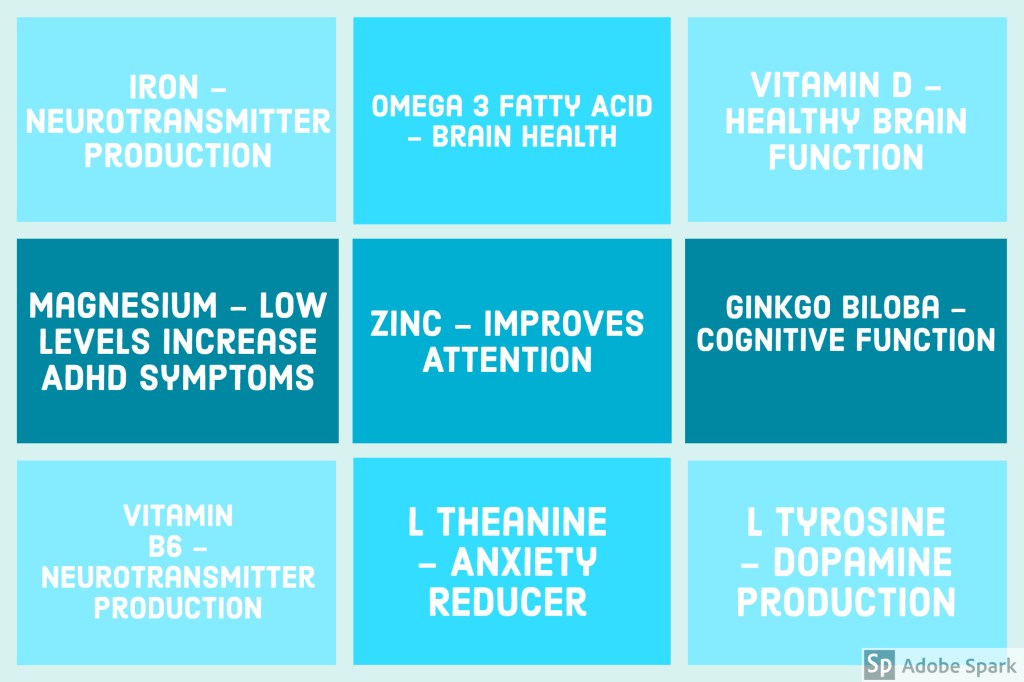
Each of these target the brain in different ways and they all work together to calm the brain and supply it with the neurotransmitters needed to function properly. There is the amino acid L-Tyrosine and the mineral Iron that are crucial in producing Dopamine, a commonly affected neurotransmitter in the ADHD brain. Ginkgo Biloba, Vitamin D, and Omega 3 fatty acids help the brain to function better. Zinc improves attention and L Theanine helps in reducing anxiety.
This is a low-cost approach that is completely natural and practical. Most of our diets have declined in the amount of good vitamins and minerals we get each day. The typical westerner’s diet is known to cause problems that are consistent with the symptoms of ADHD. We intake more saturated fats and highly processed foods and aren’t supplying our brain with the good stuff it needs. To read more about this check out: https://search.proquest.com/docview/1850765443/fulltextPDF/163391CB01B84E11PQ/1?accountid=30659
There has been other work in this area. In a 2015 study, ADHDers were given a cocktail of 36 different vitamins and minerals for 6 months. The results showed 71% of them had at least a 30% decrease in symptoms and 79% were “much improved” or “very much improved”. That’s 4 out of 5 people that felt their ADHD symptoms of inattentiveness, hyperactivity, and impulsivity were ‘much improved’ or ‘very much improved’. That’s a very high number! https://www.ncbi.nlm.nih.gov/pmc/articles/PMC4702182/
Most of us have never heard this information. We’ve been told that the only effective option is prescription medicine, but it’s just not true. The use of vitamins and minerals are breaking onto the scene and there are other options as well. Cognitive behavioral therapy, Exercise, and Diet modification are all viable treatment options that should at least be tried before medication. If all these have failed to improve symptoms of ADHD, then medication could be added, but why start with it when these natural options exist?
So, parents please consider following this more natural route. Tell your family and friends to look into it. As we move forward to the future and watch as the treatment for ADHD evolves, let’s help it evolve in a more traditional direction. Vitamins and minerals shape the world we live in and make up our bodies. It makes sense to include them in treating neurotransmitter imbalances in our brains.
Of course, always check with your doctor before changing or adding to your child’s treatment plan. I’m not advocating against using stimulant medication. But understand if the traditional stimulant medications aren’t working in your child’s case, adding supplemental vitamins and minerals may be the trick to getting their brain more focused.
 The ADHD Parent Zone